New Year’s Resolutions? No! One a Day!

This year of 2020 is coming to a close and a veritable tsunami of material is being loaded onto the internet regarding the end of one year (all the good and bad that went with it) and dawn of the new year to come (with all the good and the bad that will come with it). 

            The year 2020 will soon be gone and many people will be glad it is gone. I get this and there is a part of me that will be glad to see it go as well. 

This is not a secular blog though so I am going to inject a critical element into this writing and one that will help us  – that being of faith.  

            Faith does not have us ignore that bad stuff of life; faith has see how God is working the bad stuff of life as well as the good. We can all too easily conclude that God has “gone on vacation” as the world and perhaps our own life goes into something akin to a tailspin. 

            Each of us – I submit – needs to see all things through the eyes of faith. This does not mean that you or I will have all the answers (I don’t!). What it will allow us “to see” is that God has foreseen 2020 from all eternity. There are no oops with God! 

God has has provided – from all eternity – the grace that we need to grow in holiness. 

            God has foreseen the lockdowns; God has foreseen all of our difficult days and our good days. God could not be, cannot be and would never want to be absent from any of it. 

            There is no perfect time to become a saint AND there is no worst time not to become a saint. All times are foreseen by God and therefor it is possible to become a saint anytime in history. 

            So, as we say goodbye to 2020 it is important that each of spend time in prayer thinking about the many blessings that God has granted to. We need to give thanks to God for all of them (know and unknown to us). 

            We also need to spend time in prayer thinking of the many lost opportunities that God made available to us during this past year. It could be that we know very well we should have prayed more but did not. Perhaps we lost valuable opportunities to reach out of friends or family during COVID19. Perhaps we subjected ourselves to negative news and forget the good things happening around us. Remember – there is no perfect time to become a saint – the time is now!

            With all of this I tend to dismiss making “New Year’s resolutions” as a lot of them go by the wayside all too quickly. 

            The saints teach us to make resolutions every day – even one – and it can be a very small resolution, but they need to be made every day. 

Smiling at an annoying worker with sincerity. This may not change them – but it might! – but it will change you. Change up the resolutions but keep doing “the one” and do it intentionally. Do not underestimate the importance of small things done with love for God and others around you. 

            As we enter 2021 let us resolve to make that “one resolution” every day. Be intentional about this “one resolution.” There can, of course, be more but start with “the one” and build from there. 

            I tell people – if you start reading the New Testament for 3 minutes each day (no more and no less) you will have read 18.5 hours of the bible by the end of the year. How many people read the Bible for 18.5 hours every year? I don’t know but I suspect it is very few people. 

But with 3 minutes every day (a small action) you will accomplish a big 18.5 hours (a big action) by the end of the year.  

            May we all look to the Blessed Virgin, Mother of God, as her Solemnity brings in the New Year of 2021. Whatever it holds for us remember that God has foreseen it from all eternity and God has grace available – just waiting – for you and me to help us grow in holiness, to becomes saints!

That “one resolution” each day will help us take a step closer to being a saint. 

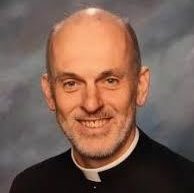
            Fr Bruce-John Hamilton 

Who Is This Child? Why Is He Here?

December 25th, 2020

Isaiah 52:7-10; Psalm 98; Hebrews 1:1-6; John 1:1-18

         What do you celebrate today? Whose birthday do we celebrate? 

It is the birthday of Jesus Christ. And who is this person – Jesus Christ – whose birthday we celebrate today. You might think he is a cute little baby, a beautiful little baby and he is that but there is more … Oh so much more and it is this “so much more” that I want all of us to focus on this Christmas morning. 

         Who is this child? And why is this child here? First – who is he? Do you know how big the universe is? There are many ways to try and describe how big it is but I’m going to describe it by numbers and with a picture (given by an astrophysicist). Imagine the universe as a sand castle where every grain of sand was a star (a sun). If this sandcastle was to represent the size of the universe it would have to be five miles high, five miles long and five mile wide. Did you get that: 5 high, wide and long. Oh – and it is still expanding. 

If you are a numbers person – lots of accountants in this parish! – then our sun can hold 960,000 Earths (and it is a small sun). The biggest known Sun is called “The Big Dog” – it can hold seven quadrillion Earths (did you get that!). If you began to count right now to 1 million it would take you eleven and a half days. If you counted to a trillion – it’d take you thirty-one thousand years. Counting a quadrillion seconds? Thirty-one million years. You can put seven quadrillion earths into the biggest star which is just one of hundreds of billions of stars. This is described in one of the densest verses in Scripture: Genesis 1:16: “… he made the stars also.”

Is your head blowing off yet! Are you getting the magnitude of this! 

This is mind boggling – it can wow the brain and make it hurt at the same time. Well – this universe that is still expanding was made by this baby AND it is be sustained in existence by this baby. 

         Now does that begin to make an impact on how you answer the question: who is his baby, who is this child? This child is God, the 2nd Person of the Holy Trinity. The power that it takes to bring everything into existence is way beyond you and me. Imagine if this God – who made all this and sustains all this came to us as he really is. How would we respond? We’d probably be terrified. So what does God do – he comes to us as a baby who arms are reaching out to us.

         Why is this child here – why did the word become flesh? 

The Church gives four main reasons

Number one –This baby is here is to save us by reconciling us with God. To be clear – this baby is here – for war! He is here to save us from sin and that means savings us from someone and from something – from sin and the devil. Sin is that which separates us from God, from the people we love and even from ourselves. This baby is here to save us – to believe anything less is to water down the reality of why this child is here and the importance of this day.

There are many people who just stop there. They think that Jesus came into the world to save us from sin and hell. While this is true it is only the beginning. 

The second reason he is here is to reveal God’s love to us.  St. Thomas Aquinas teaches that that God could have saved humanity simply by declaring us to be forgiven. But he didn’t do that, he chose to become man and then go to the cross to show us that he doesn’t just want to save us, but that he loves us. And he knew that in the incarnation and the crucifixion, there would be no greater way to show us that he loves us, than to become man and then go to the cross and die for us. “For greater love hath no one than this, that he lay down his life for someone else / for his friends” (see John 15:13). So, God wanted to show us that he loves us, and he does that through the incarnation and the cross.

         He wanted to save us. He wanted to show his love for us. It doesn’t stop there. The third reason is that he also wants us to love him in response to what he has done for us. He could have just made, saved and shown his love for us and that was it. But he actually wants us to respond to him with love – but freely, not with force or any coercion. And in order to help us do this he shows us how to love His Father and in loving his Father to become holy. This just can’t get any better – but it does! There is one more reason.

         The fourth reason the Catechism teaches why this child is here is perhaps the greatest of all. He is here in order that we might have a share in the divine nature. In other words, to make us sharers in his divine life. There is a very powerful passage in the Catechism, quoting some of the Saints: “this is why the Word became man, and the Son of God became the Son of man: so that man, by entering into communion with the Word and thus receiving divine sonship, might become a son of God” (CCC 460). And then again, this is from St. Athanasius, “the Son of God became man so that we might become God” (CCC 460). And then finally, St. Thomas Aquinas, this is most staggering of all: “The only begotten Son of God, wanting to make us sharers in his divinity, assumed our nature, so that he, made man, might make men gods.” (CCC 460).

         When parents look at their new born baby they are awed and think “look what we did.” Isn’t that true all you moms and dads? 

Well – when you look at this baby – look up at the skylook at a crosslook into the crib and finally look in the mirror and think “look what he did … for me.” 

         My brothers and sisters – this is the mystery of Christmas that lays there in the crib, right there on the cross and now this God who creates, rescues, loves, wants to be loved and desires to unite us to himself … this God is going to be right here on the altar in the Eucharist because this God doesn’t just walk away or go into retirement. He is with us! Merry Christmas! 

Something New – This Blog

There are so many blogs on the internet so why another one. There are many answers but my answer is actually a few points: 1) in this so-called digital age it is important that if people are looking on the net and very few are not then I want to do what I can to put something “out there” that people can be encouraged by, formed well by and generally just be lifted up; 2) People find it very hard to connect what they hear from the pulpit or read in the Bible with their every day life. I want to at least try to help people bridge that reality. Scripture is packed with the greatest of all wisdom – from Genesis to Revelation. There is so much wisdom that we are all too often oblivious to and therefore we often feel like we are behind the proverbial eight-ball in our day-to-day living. 

            My intentions are somewhat ambitious but that seems to “be me.” I hope and pray that this helps even one person and maybe more. I may hop from subject matter to subject matter as I am impressed upon or affected by what I hear, see and read. This first blog has to do with a virtue that is in short supply these days and is badly needed: Patience! Everyone feels that lack of patience at times and all too often we hear ourselves losing our patience through grunts and groans and perhaps even through words than we would not want children to hear or put into social media posts where they will be for “virtual eternity” and may very well come back to embarrass and haunt us.  

Patience – I’m going to tackle it and I hope to give you something to help you grow in being patient with God (yes, that is right … with God), yourself and others. 

Patience

How often have you heard yourself saying to yourself or in confession “I have no patience” or some form of this —- ‘I have to be more patient with that person or this situation’ or ‘I have less and less patience as I get older’.  Sometimes this is said quite flippantly but in many cases the person is quite disconcerted about this as the lack of patience – reflected in bad temper, giving up ventures and a whole host of things is really affecting them.  It is helpful to talk about what patience is, what are the enemies of patience and how can we strive for patience.  

            I believe it to be true that when many people say ‘I really have to be patient with this person’ what they are thinking is that they have to have some sort of control over the irritation or anger that this person seems to cause within us.  Hence – we tend to think of patience as some sort of serenity: the power of enduring trouble, suffering inconvenience, without complaining.  

            Or we might think of patience as some capacity to bear the delay of goods which do not come as fast as we would like: “I have to be patient before I save enough to buy a car.”  This notion refers to the capacity to bear sacrifices for a long time until we attain a certain joy.  Patience, here appears as the ability to wait for results, to deal with problems without haste.  

            There are attitudes about suffering that we have to be aware of  but also be aware that they are attitudes that are false.  The stoic attitude is one of endurance but only because it considers suffering inescapable no matter what you may do.  The Buddhist attitude is one of eliminating suffering by killing any desire and thus any frustration or suffering.  The attitude of apathetic inertia is that of the lukewarm person who prefers to remain in his situation because he thinks that any change will demand some effort or that he or she might end up in a worse situation.  All of these lack something to make them virtuous because the subject does not endure suffering for the sake of an objective good, which is the goal of any virtue.  

            From a human point of view, patience is necessary for any person. Definitively, patience has to do with suffering.  Patience – as a human virtue – could be defined as the capacity or habit of enduring evil, adversity, or pain with fortitude or courage.  Patience as relate to fortitude adds serenity to the soul so that emotions can be controlled. Two elements basically define patience: the lasting or persistent presence of suffering and the serenity to endure it without giving up or getting angry.  

            Now it is important to unveil – or define – what is characteristic of Christian patience.  What is important to understand for the Christian are the following:

•           From the kind of evil that is endured

•           From the power used to endure and,

•           From the motivation of the person enduring evil. 

The human virtue of patience encounters suffering as anything contrary to one’s liking.  Christian patience faces the suffering that comes from being or acting as a genuine Christian.

In human patience we rely on sheer will power or self-control of negative emotions to overcome difficulties.  A person moved by Christian patience relies also on the power of God’s grace.  This supernatural power enables us to take with serenity whatever long suffering may come or be demanded in order to accept or carry out God’s will.  And so real patience is not merely a passive disposition but more of an active disposition to accept God’s will and God’s ways.  

The motivation of human and Christian patience is also different.  In human patience a person is motivated by the hope of obtaining a certain natural good or joy.  Christian patience is motivated by the three theological virtues, faith, hope and charity.  The person wants to please God and attain Him or his blessings.   

And so we can state the definition of Christian patience to be:  a part of the virtue of fortitude – is the virtue that enables a person to bear physical and moral sufferings, trying circumstances, and obstinate personalities without sadness of spirit or dejection of heart, but with equanimity born of love of God.

            Patience is not something that comes all at once.  There are degrees to this virtue.  Five main stages can be distinguished in a person who is growing in patience:

1)         Resignation without complaint or impatience with respect to the crosses that the Lord sends us or permits us to endure

2)         Peace and serenity in the face of affliction, without the sadness or depression that sometimes accompany mere resignation.

3)         Acceptance of God’s will and God’s ways, which lead us to desire and accept whatever cross comes our way.

4)         Total and complete joy for being associated with God in the mystery of the Cross.

5)         The folly of the Cross, which made St. Paul feel strong in his suffering while preaching Christ crucified; what looks as foolishness to men, is really the wisdom of God:

“For the word of the cross is folly to those who are perishing, but to us who are being saved it is the power of God … For Jews demand signs and Greeks seek wisdom, but we preach Christ crucified, a stumbling block to Jews and folly to Gentiles, but to those who are called, both Jews and Greeks, Christ the power of God and the wisdom of God. For the foolishness of God is wiser than men, and the weakness of God is stronger than men.” (1 Cor 1:18, 22-25)

The enemies of patience are basically twofold: 1) falling into discouragement and sadness; b) falling into anger.  By the first we stop from pursuing the good, by the second we try to get rid of a necessary suffering in the wrong way.  In pursuing the good – trying to do the right thing – we all have to face the three enemies of the soul: the world, the flesh and the devil.  Thus, facing failure, one needs the virtue of patience to react at once against sadness, and avoid drifting into discouragement.   

A person may also respond to a present evil by over-reacting and getting angry with everyone; anger is another outlet for impatience.  Impatience triumphs when we allow the trials of everyday life to dominate us; thus, we resort to grumbling, complaining, constant bickering, and to fits of bad temper.  

How to Grow in Patience   

As with any other supernatural virtue we need the light and power of grace along with our human effort in order to grow in patience.  And so we need to pray (the prayer of petition) in order to receive God’s grace and strengthen our resolve to acquire patience.  

            As well we need meditative prayer in order to discern with the Lord whether He wants us to change or solve the cause of suffering, or instead, to accept it; this is meditative prayer.  Then we have to ask the Lord either for courage to change the cause or patience to endure the suffering we cannot change.   Think about the Serenity Prayer here. 

In the case of persons who resist our efforts to help them change, we need also reflective prayer on the meaning of Christian suffering and how to go about it.  We need to reflect on God’s patience with sinners, on the life, passion, death, and resurrection of Jesus Christ.  We can also learn from the saints as to how they dealt with difficult situations in their lives. Reading a good article of a biography of a saint can do more good than you might imagine. It has brought about the conversion of many people – e.g., Edith Stein, Ignatius of Loyola. 

We all know – or should know – that none of this (patience) is or will be possible unless we have a resolve, a determined effort to beseech God for his grace and use the sources we have in order to do that (the different kinds of prayer, scripture, the saints) along with a persevering effort on our part.  

If we are willing to do this then we can be assured that we will grow in patience and the very fact that it will not come all at once will prove that we are determined to grow in this all important virtue – of patience. 

Sourced from Charles Belmonte, Patience: The Path to Victory